
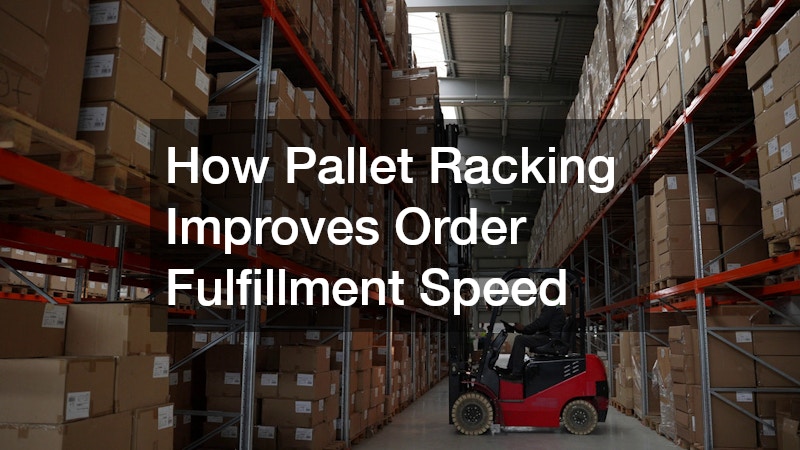
Order fulfillment speed has become one of the most important performance indicators in modern warehousing and logistics. Customers expect fast, accurate deliveries, and businesses that cannot keep up often lose out to more efficient competitors. One of the most effective ways to improve warehouse performance is through better storage organization and accessibility. Well-designed systems like pallet racking help streamline inventory flow, reduce search time, and support faster picking operations. When products are easier to locate and retrieve, every step of the fulfillment process becomes more efficient, from receiving stock to shipping final orders.
This creates a smoother workflow that directly impacts customer satisfaction and operational costs.
Why Speed Matters in Order Fulfillment
Speed in order fulfillment is not just about working faster—it is about eliminating wasted motion, reducing delays, and improving accuracy throughout the process. Every extra minute spent searching for inventory or correcting picking errors adds up across hundreds or thousands of orders. Slow fulfillment can lead to late shipments, increased labor costs, and dissatisfied customers. In competitive industries like e-commerce and retail distribution, even small inefficiencies can have a major impact on profitability. Warehouses that prioritize speed are able to process higher order volumes without needing to significantly increase staff or operating hours. This creates a scalable model that supports long-term business growth while maintaining service quality.
How Storage Organization Impacts Picking Efficiency
Efficient storage layout plays a major role in how quickly workers can complete picking tasks. When inventory is disorganized or stored inconsistently, employees spend more time walking, searching, and verifying product locations. This reduces overall productivity and increases the likelihood of errors. A structured storage system ensures that high-demand items are placed in accessible locations, while slower-moving products are stored in secondary areas. Clear labeling, logical zoning, and consistent placement rules all contribute to a more predictable workflow. As a result, warehouse teams can complete more orders in less time with fewer mistakes, improving both speed and accuracy across operations.
The Role of Warehouse Layout and Accessibility
A well-planned warehouse layout directly influences how efficiently goods move through each stage of fulfillment. Accessibility is especially important because it determines how quickly workers can reach inventory without unnecessary obstacles. In many modern facilities, pallet racking is used to maximize vertical space while keeping products organized and easy to retrieve. This setup reduces congestion in aisles and ensures that items are stored in clearly defined locations. By improving visibility and access, workers can identify and pick products faster, reducing downtime between tasks. Over time, this leads to a more consistent and reliable fulfillment process that supports higher order volumes and improved customer satisfaction.
Technology and Workflow Integration
Modern warehouses increasingly rely on technology to improve speed and accuracy in order fulfillment. Systems such as barcode scanners, warehouse management software, and automated tracking tools help streamline operations and reduce manual errors. When these technologies are integrated with organized storage systems, the benefits are even greater. Workers can quickly locate items, verify inventory levels, and confirm order details in real time. This reduces confusion and minimizes delays caused by incorrect picks or missing stock. The combination of digital tools and efficient physical storage design creates a synchronized workflow that significantly improves overall warehouse performance.
Operational Impact on Daily Warehouse Flow
When warehouse systems are well-structured and processes are clearly defined, the impact on daily operations is immediate and measurable. Teams spend less time dealing with misplaced inventory, unclear procedures, or inefficient movement paths, which allows more focus on completing orders accurately and quickly. Communication between picking, packing, and shipping teams also improves because workflows become more predictable and standardized. Over time, this consistency reduces bottlenecks, increases throughput, and creates a more stable fulfillment environment that can handle fluctuations in order volume without sacrificing performance or accuracy.
Reducing Errors and Improving Accuracy
Accuracy is just as important as speed in order fulfillment. Mistakes such as sending the wrong item or shipping incomplete orders can lead to costly returns and damage customer trust. A structured storage environment helps reduce these errors by ensuring that every product has a clearly defined location. When items are consistently stored in the same place, workers are less likely to make picking mistakes. Standardized processes also make training new employees easier, allowing them to become productive more quickly. Over time, improved accuracy leads to fewer disruptions in the fulfillment cycle and a more reliable operation overall.
Improving order fulfillment speed requires a combination of organization, efficiency, and smart operational design. Businesses that invest in better warehouse structure and streamlined processes are able to handle higher demand while maintaining accuracy and consistency. In many facilities, pallet racking plays a key role in achieving this balance by supporting organized storage and faster product access. When inventory is easy to locate and retrieve, every step of the fulfillment process becomes more efficient. Over time, pallet racking helps reduce delays, improve workflow consistency, and create a more scalable system that supports long-term business growth.